The construction industry has always changed slowly. For many years, builders depended on familiar materials, known methods, and locally available resources.
However, in recent times, things have started to change faster. Rapid urban growth, shorter project timelines, stricter energy rules, and increasing focus on sustainability are changing how buildings are designed and built.
One clear result of this change is the shift in the choice of masonry materials across the world. Today, materils are not chosen only based on tradition or availability. Instead, builders now look at performance, efficiency, and long-term value.
Traditional Masonry Materials and Their Global Dominance
For many years, two materials have been widely used in construction across the world:
- Fired red bricks
- Concrete masonry units (CMUs)
Concrete blocks became popular in developed countries because they are strong and flexible. Their hollow spaces allow steel reinforcement, making them suitable for load-bearing structures. Their larger size also helps in faster construction compared to regular bricks.
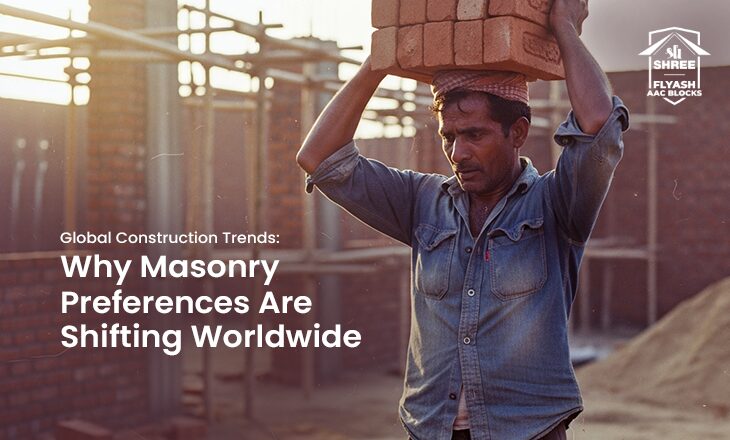
Red bricks, on the other hand, have been widely used across Asia, Africa, and the Middle East. They are strong, familiar, and have been used for generations. Over time, entire construction systems, labour skills, and supply chains were built around brick usage. This is why the shift away from bricks is gradual.
Why Conventional Masonry Is Being Reconsidered
Even though traditional materials are still widely used, modern construction needs are exposing their limitations.
Today, buildings are expected to perform well throughout their life, not just provide strength. Red bricks:
- Require high energy during manufacturing
- Use natural resources extensively
- Add extra weight to buildings
- Slow down construction due to the smaller size
Concrete blocks:
- They are strong but often need extra insulation
- May not meet modern energy standards on their own
Because of these reasons, builders are now asking an important question:
“Which material performs better for today’s needs?”
The Shift Toward Performance-Based Masonry Systems
Modern developers, architects, and engineers now choose materials based on performance factors such as:
- Faster construction
- Reduced labour effort
- Lower structural load
- Better temperature and sound control
- Environmental impact
This approach has increased the use of advanced masonry materials that offer multiple benefits in one solution. One such material is AAC Blocks, also known as Autoclaved Aerated Concrete Blocks, which are gaining strong global acceptance.
Why AAC Blocks Are Gaining Global Acceptance
AAC Blocks are made using cement, lime, water, and industrial by-products like fly ash. During manufacturing, a special process creates tiny air pockets inside the blocks, making them lightweight and efficient.
One of the biggest advantages of AAC Blocks is their lightweight nature. This reduces the overall weight of the building, which helps in better structural design and can reduce foundation costs—especially useful in large-scale and high-rise projects.
Understanding Thermal Performance
Thermal performance means how well a material controls heat movement.
- Materials with good thermal performance keep heat out during hot weather
- And keep indoor spaces warm during colder conditions
Autoclaved Aerated Concrete Blocks have tiny air pockets inside them. Air slows down heat transfer, which helps in maintaining stable indoor temperatures. Because of this:
- Buildings stay cooler in summer
- Stay warmer in winter
- Use less electricity for cooling and heating
This improves comfort and reduces energy costs over time.
Construction efficiency is another strong benefit of AAC Blocks:
- Larger size means faster wall construction
- Easy to handle and cut
- Requires less labour
This makes them ideal for projects with tight deadlines.
Global and Indian Market Trends
Globally, Autoclaved Aerated Concrete Blocks are widely used in Europe and parts of East Asia, where energy efficiency rules are well established. These regions have shown that lightweight masonry can perform better than traditional systems without compromising strength.
In India, a similar shift is happening. Rapid urbanisation, increasing land costs, and growing awareness of energy-efficient construction are influencing material choices—especially in cities like Delhi NCR, Noida, and Gurgaon.
Fly ash-based AAC Blocks are now being seen not as a replacement, but as a natural improvement over traditional masonry.
Sustainability as a Long-Term Driver
Sustainability is becoming an important factor in construction decisions. AAC Blocks support sustainability by:
- Reducing the use of natural resources
- Using industrial waste like fly ash
- Improving energy efficiency in buildings
As environmental regulations become stricter, materials like Autoclaved Aerated Concrete Blocks are expected to see steady growth in demand.
Looking Ahead
Red bricks and concrete blocks will continue to be used, especially in regions where traditional construction methods are deeply rooted.
However, their dominance is gradually being challenged by materials that offer better performance.
Manufacturers focused on quality-driven, fly ash-based AAC Blocks, such as Shree Flyash, are well-positioned to support the future of modern and efficient construction.
Conclusion
The future of construction is no longer based only on strength or tradition.
It is now driven by efficiency, sustainability, and long-term performance.
Autoclaved Aerated Concrete Blocks are increasingly becoming a preferred choice as they meet all these requirements. This reflects a broader shift towards smarter and more responsible building practices.