
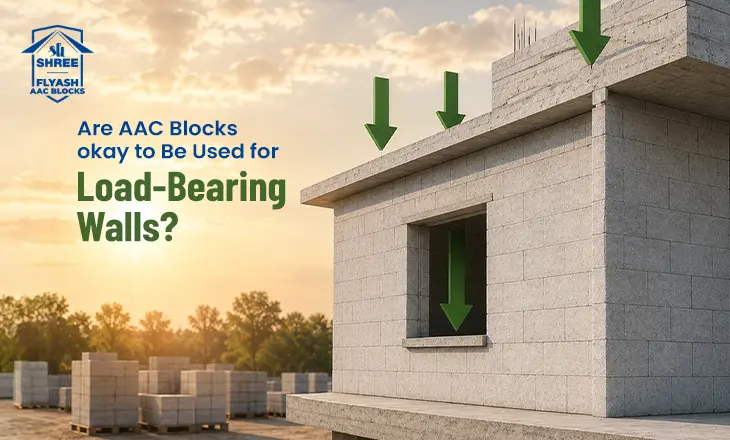
For years, traditional red bricks and concrete blocks dominated the conversation around structural wall construction. So when AAC blocks started becoming popular across modern projects, one question naturally began coming up more frequently:
Can AAC blocks actually be used for load-bearing walls?
It is a fair question.
After all, AAC blocks are lightweight. And in construction, people often associate “heavier” with “stronger.” That assumption has existed for decades. But modern construction materials are changing many of those conventional beliefs.
Today, leading brands like Shree Flyash AAC Blocks are transforming residential and commercial projects by offering exactly what modern structural engineering demands. Unmatched efficiency without compromising load performance.
Still, when it comes to structural applications, especially load-bearing walls, understanding where and how AAC blocks can be used becomes extremely important.
Because the answer is not simply “yes” or “no.”
It depends on factors like:
- Compressive strength
- Building design
- Structural load calculations
- Wall thickness
- Quality of the blocks
- Engineering specifications
This guide explains how an AAC block wall performs in structural applications, whether AAC blocks are suitable for load-bearing walls, and the practical considerations that builders, architects, and homeowners should understand before making a construction decision.
What Exactly Is a Load-Bearing Wall?
Before understanding whether AAC blocks can be used structurally, it is important to first understand what a load-bearing wall actually does.
A load bearing wall is not just a partition wall dividing spaces.
It is a structural element that carries and transfers the load of the building above it down to the foundation.
This load may include:
- Roof load
- Floor slab load
- Beam load
- Structural dead load
- Live load from occupancy and usage
In simple words, these walls help support the building itself.
That is why the material used in load-bearing walls must have sufficient compressive strength and structural reliability.
And this is where the discussion around AAC blocks becomes interesting.
Why AAC Blocks Are Often Misunderstood Structurally
One of the biggest reasons people doubt AAC blocks in load-bearing applications is because of their lightweight nature.
AAC blocks contain millions of tiny air pockets formed during the manufacturing process. These air voids reduce the overall density of the block, making it significantly lighter than conventional clay bricks or concrete blocks.
Naturally, many people assume:
“If it is lightweight, it must be weak.”
But structural engineering does not work that way.
Weight and strength are not always directly proportional.
In fact, one of the major advantages of AAC blocks is that they reduce the dead load of the structure substantially. A lighter building places less load on beams, columns, and foundations.
That reduction in structural load is one of the reasons AAC blocks are widely preferred in modern framed structures.
However, the key factor is not weight alone.
It is compressive strength.
Can AAC Blocks Be Used for Load-Bearing Walls?
The short answer is:
Yes — AAC blocks can be used for load-bearing walls, provided the blocks meet the required compressive strength standards, and the structural design supports their use.
High-quality AAC blocks are manufactured to achieve compressive strengths suitable for specific structural applications. In low-rise construction, especially smaller residential structures, AAC blocks may be used in load-bearing wall systems depending on engineering requirements.
However, structural suitability always depends on:
- Building height
- Design load
- Soil condition
- Structural system
- Local building regulations
- Block grade and density
This is why structural approval from a qualified engineer is essential before finalising any load-bearing wall system.
AAC blocks are not a “one-size-fits-all” structural solution.
But under the right conditions, they can absolutely perform effectively in load-bearing applications.
Why AAC Blocks Are Commonly Used in Framed Structures
While AAC blocks can be used for load-bearing walls in certain projects, they are more commonly used in RCC framed structures.
In framed construction:
- Columns and beams carry the structural load
- Walls mainly act as partition and enclosure elements
This is where an AAC block wall becomes highly effective because the reduced wall weight lowers the total dead load on the structure.
And that creates several practical advantages:
- Reduced structural stress
- Faster construction
- Lower steel consumption
- Better earthquake performance
- Reduced foundation load
In many modern buildings, AAC blocks are preferred specifically because they make the overall structure lighter and more efficient.
So even when they are not acting as primary load-bearing elements, they still contribute significantly to structural performance.
The Importance of Compressive Strength in AAC Blocks
When discussing AAC block for load-bearing walls, compressive strength becomes one of the most important technical factors. Compressive strength refers to the ability of a material to withstand load without failure. Different AAC block grades offer different strength levels depending on density, manufacturing quality, curing processes and raw material composition.
This is why block quality matters enormously. Low-grade blocks with inconsistent manufacturing standards should never be considered for structural applications. A high-quality fly ash AAC block manufactured under controlled conditions provides:
- Consistent density class engineered via fully automated German Wehrhahn technology.
- Reliable compressive strength complying strictly with IS 2185 (Part III) standards.
- Better dimensional accuracy to ensure predictable structural performance.
- Improved long-term durability for engineered masonry walls.
In structural construction, consistency is just as important as strength itself because predictable performance creates safer structures.
How AAC Blocks Improve Structural Efficiency
Interestingly, one of the biggest structural advantages of AAC blocks is not just their strength — it is their weight reduction capability.
Traditional clay bricks significantly increase dead load due to their higher density.
AAC blocks, being much lighter, reduce:
- Beam load
- Column load
- Slab stress
- Foundation pressure
This reduction can positively influence the overall structural design efficiency of the building.
In seismic zones, especially, lighter walling materials often improve earthquake performance because lower structural mass results in reduced seismic force generation.
That is one reason AAC blocks are increasingly preferred in modern urban construction.
Are AAC Blocks Suitable for All Types of Load-Bearing Construction?
Not necessarily.
This is where realistic understanding becomes important.
AAC blocks may perform effectively in:
- Low-rise residential buildings
- Certain engineered load-bearing systems
- Structurally designed masonry applications
However, high-rise and heavily loaded structures generally depend on RCC framed systems where AAC blocks function as non-load-bearing walls.
The suitability always depends on engineering calculations — not assumptions.
Construction materials should never be selected based only on popularity or trends.
They should be selected based on:
- Structural requirements
- Design intent
- Safety considerations
- Technical specifications
And that decision should always involve qualified structural professionals.
Why Proper Installation Still Matters
Even the best construction material performs properly only when installation standards are followed correctly.
For AAC block walls, proper installation includes:
- Specialised polymer mortar application
- Uniform joint thickness
- Proper reinforcement
- Accurate alignment
- Controlled cutting practices
Poor workmanship can affect wall performance regardless of the material being used.
That is why professional execution becomes just as important as material selection in modern construction.
The Growing Role of AAC Blocks in Modern Construction
The construction industry today is steadily moving toward materials that offer:
- Structural efficiency
- Faster execution
- Better sustainability
- Improved thermal performance
- Reduced overall building load
AAC blocks fit naturally into that transition.
Their combination of lightweight performance, insulation capability, dimensional accuracy, and workability has made them increasingly relevant across contemporary construction projects.
And as engineering practices continue evolving, the use of AAC block wall systems is likely to expand even further across different building applications.
Conclusion
So, are AAC blocks okay to be used for load-bearing walls?
Under the right structural conditions and engineering specifications — yes, they can be.
But the more important point is understanding that AAC blocks are not simply “lightweight alternatives” to traditional masonry. They are engineered construction materials designed to improve overall building efficiency in multiple ways.
Whether used in load-bearing applications or framed structures, AAC blocks contribute to:
- Reduced dead load
- Faster construction
- Better thermal insulation
- Improved workability
- More efficient structural systems
At the same time, their suitability for structural applications should always be evaluated through proper engineering assessment rather than assumptions alone.
Because in modern construction, smart material selection is not about choosing the heaviest option.
For architects, structural consultants, and developers managing modern projects, choosing the right material is a choice of long-term structural integrity. Shree Flyash AAC Blocks provide the perfect balance of lightweight efficiency and verified compressive strength.