
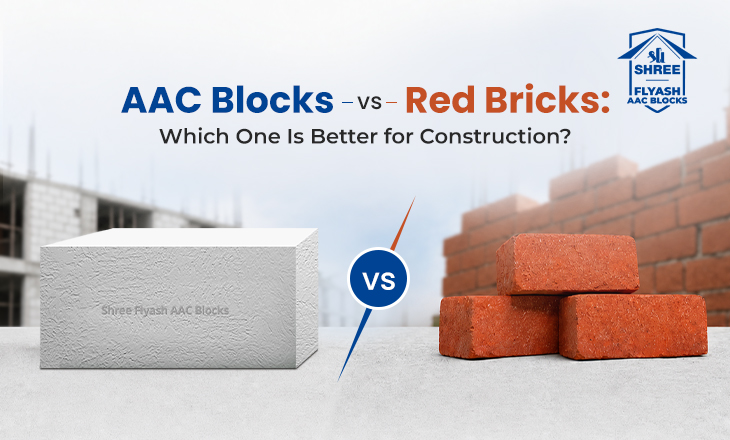
Choosing the right material for building walls is an important decision during any construction project. For decades, red bricks have been the traditional choice for homes and commercial buildings. However, with advancements in construction technology, AAC blocks (Autoclaved Aerated Concrete blocks) have become a popular alternative due to their lightweight nature, better thermal insulation and their ability to increase the speed of construction.
So, which is the best choice? The answer depends on factors like construction requirements, budget, durability, and long-term benefits.
What Are AAC Blocks?
AAC blocks are lightweight concrete blocks manufactured using materials like cement, fly ash, lime, water, and an expanding agent. Their internal air pockets make them lighter than traditional bricks while providing good thermal insulation.
What Are Red Bricks?
Red bricks are one of the oldest and most widely used construction materials. They are made by shaping clay and firing it at high temperatures to achieve strength and durability.
AAC Blocks vs Red Bricks: Key Differences
| Factor | AAC Blocks | Red Bricks |
| Weight | Lightweight and easier to handle | Heavier compared to AAC blocks |
| Construction Speed | Faster due to larger block size | Slower due to smaller brick size |
| Mortar Usage | Requires less mortar due to fewer joints | Requires more mortar for multiple joints |
| Thermal Insulation | Provides better insulation against heat | Offers moderate insulation |
| Surface Finish | Provides a smoother wall surface | Their surface is rougher and requires more plastering |
| Environmental Impact | Is more environment friendly as uses industrial by-products like fly ash. | Soil degradation as clay excavated and kiln firing leads to air pollution |
1. Strength and Durability
Both AAC blocks and red bricks can provide durable construction when used correctly. The overall strength of a structure depends on factors such as material quality, design, workmanship, and proper installation.
AAC blocks offer factory-manufactured dimensional consistency, helping with uniform wall construction. Red bricks, on the other hand, have been trusted for generations because of their proven performance in various construction applications.
2. Construction Speed and Labour Efficiency
One major advantage of AAC blocks is their larger size compared to traditional bricks. A single AAC block can cover a larger wall area, reducing the number of joints and speeding up the construction process which helps reducing labor cost substantially.
Fewer joints also mean reduced mortar consumption and easier handling during installation, which helps support smoother site execution and improved construction productivity.
3. Weight and Structural Benefits
AAC blocks are significantly lighter than conventional red bricks. Their lightweight property reduces the dead load of the building, which is especially beneficial in multi-storey construction projects as it reduces the requirement of steel and concrete when the foundation is being constructed.
A lighter structure can also help reduce raw material and transportation cost and improve overall construction efficiency.
4. Thermal and Sound Insulation
Maintaining indoor comfort is an important consideration for modern buildings. AAC blocks contain tiny air pockets that help reduce heat transfer. In India which has very hot summers, this helps keep the interiors cooler and that translates into less Air conditioning requirements.
They also provide better sound insulation compared to traditional brick walls, making them suitable for homes, offices, and other spaces where noise reduction is important.
5. Overall Construction Cost
While the initial cost of AAC blocks may appear slightly higher compared to individual red bricks, the overall construction cost depends on several factors, including labour, mortar requirement, transportation, and finishing work.
Since AAC blocks require fewer joints, lower mortar consumption and faster installation, they may contribute to improved overall construction efficiency depending on project design and execution.
The other aspect to consider is the smooth factory finish of AAC blocks, these are much smoother that Red bricks. So the walls made of Red bricks need a lot of plastering to get a good finish, while plaster requirements of AAC block walls is much lesser.
Which One Should You Choose: AAC Blocks or Red Bricks?
There is no single answer that works for every project. Red bricks remain a reliable option due to their traditional use and availability. However, AAC blocks are increasingly preferred for modern construction because of their lightweight design, faster installation, and insulation benefits.
Before selecting the material, consider your project type, location, design requirements, and advice from your structural engineer.
Explore Shree Flyash AAC Blocks to learn more about precision-manufactured AAC solutions and make a more informed construction decision. AAC Blocks vs Red Bricks.
Making the Right Choice
Both AAC blocks and red bricks have their own advantages. While red bricks remain a familiar construction material, AAC blocks offer efficient edge and technical advantages such as lower structural load, improved thermal insulation and faster construction, making them well-suited for vivid modern building applications.
Understanding the differences between these materials helps homeowners, builders, and professionals make a more informed decision for durable, efficient, and sustainable construction.