
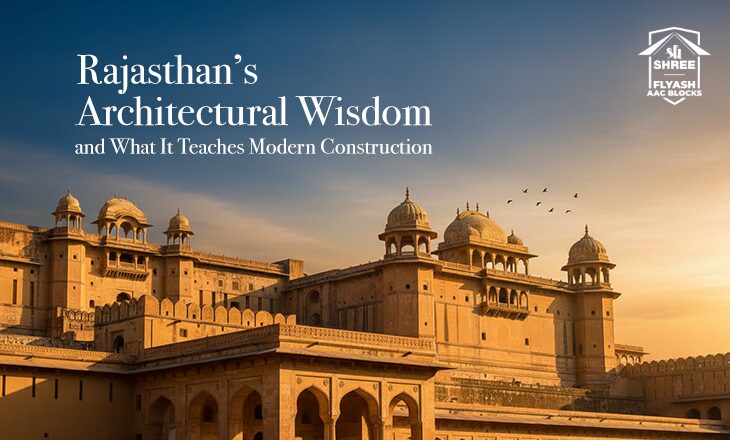
When we talk about sustainable construction today, the conversation often revolves around new-age materials, certifications, and technologies. But long before sustainability became a global priority, regions like Rajasthan had already mastered it — not through innovation labs, but through necessity.
Rajasthan’s architectural identity is deeply shaped by its harsh climate. Scorching heat, water scarcity, and extreme temperature fluctuations demanded buildings that could endure — and more importantly, adapt. The result was a design philosophy rooted in performance, practicality, and longevity.
Today, as the construction industry looks for smarter and more responsible ways to build, these traditional principles are becoming relevant again — not as relics of the past, but as foundations for the future.
Designing for Climate, Not Against It
One of the most striking aspects of traditional Rajasthani architecture is how intuitively it responds to climate.
Thick walls acted as natural insulators. Small windows reduced heat ingress. Courtyards created microclimates that allowed air to circulate and cool interiors naturally. Elements like jalis filtered sunlight while maintaining ventilation.
These weren’t aesthetic choices alone — they were performance-driven decisions.
Modern construction, despite its technological advancements, often revisits these same goals: reducing heat gain, improving thermal comfort, and lowering dependence on artificial cooling.
The difference lies in how these outcomes are achieved today — often through a combination of design and material innovation.
The Shift Towards Smarter Materials
While traditional architecture relied heavily on locally available stone and clay, modern construction has a wider palette of materials to choose from. The focus, however, remains the same: efficiency and durability.
This is where discussions around materials like AAC blocks quietly enter the picture. Not as a replacement for traditional wisdom, but as a continuation of it — offering solutions that align with the same principles of thermal efficiency and structural balance.
In broader industry conversations, comparisons such as AAC blocks vs red bricks are often used to evaluate how materials perform under modern construction demands. But beyond the comparison itself, what truly matters is how well a material contributes to the overall efficiency of a building.
Performance Over Preference
Traditional Rajasthani construction wasn’t driven by trends — it was driven by performance. Every design element served a purpose, whether it was reducing heat, conserving water, or ensuring structural stability over decades.
That same mindset is crucial today.
Material selection, for instance, is no longer just about cost or availability. It’s about long-term performance — how a structure behaves over time, how it responds to environmental stress, and how much maintenance it demands.
In this context, modern materials — including AAC blocks — are often evaluated for factors like consistency, weight, and thermal behaviour. Not as a marketing narrative, but as part of a larger effort to build structures that last longer and perform better.
Blending Heritage with Modern Needs
One of the most interesting shifts in contemporary architecture is the blending of traditional aesthetics with modern construction techniques.
Across India, you’ll see buildings that retain elements inspired by Rajasthan — textured facades, shaded openings, earthy tones — while being built using contemporary systems behind the scenes.
This approach allows architects to preserve cultural identity without compromising on efficiency.
It also reflects an important idea: sustainability doesn’t mean choosing between old and new — it means integrating both intelligently.
Rethinking Urban Construction
As cities expand rapidly, the pressure on resources, energy, and infrastructure continues to grow. This has made sustainable construction less of an option and more of a necessity.
Interestingly, many of the solutions being explored today — energy-efficient buildings, reduced material wastage, faster construction methods — echo the same intent that guided traditional architecture.
Even discussions around AAC blocks manufacturing process or other controlled production systems are, at their core, about achieving consistency and reducing unpredictability in construction.
But the larger takeaway isn’t about any one material — it’s about adopting a more thoughtful approach to building.
The Way Forward
Rajasthan’s architectural legacy reminds us that sustainability isn’t a modern invention — it’s a time-tested principle.
What’s changing today is how we apply it.
By combining traditional design intelligence with modern construction practices, the industry has an opportunity to build structures that are not just efficient, but also contextually relevant and environmentally responsible.
The future of construction doesn’t lie in choosing between heritage and innovation — it lies in understanding how both can work together.